How to compare home appliances without an invented best list
Build a useful appliance shortlist around fit, daily tasks, installed cost and evidence. Learn which details to collect before comparing offers.
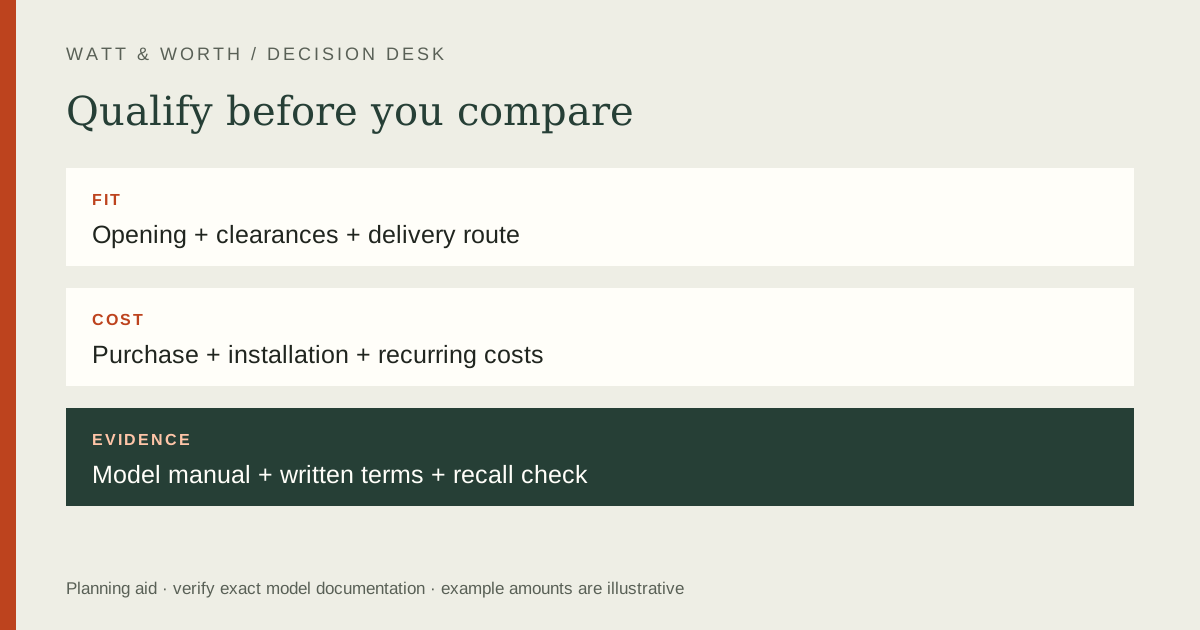
The best home appliance comparison begins with a short requirements sheet, not a ranked shopping list. Eliminate models that cannot fit, cannot be installed or cannot handle your regular tasks. Then compare the remaining options using complete installed prices, documented energy use and written seller terms. This method cannot promise a universal winner, but it makes the reason for your choice visible.
Decide what the appliance must do
Write down the problem you are replacing, not just the product you own. A refrigerator might need to hold wide meal-prep containers, open beside a wall and provide reachable freezer storage. A washer might need to handle bedding without blocking a hallway. A home-office device might need a particular connection and usable controls without an account.
Separate requirements into three groups: essential, useful and optional. Keep the essential list short enough to be decisive. An ice dispenser could be essential for one household and an unnecessary water connection for another. A feature is valuable because of your routine, not because it is prominent in the sales photograph.
For shared homes, have each user try the controls and access points. Reach, grip, visibility and door resistance are practical requirements. A capacity figure cannot show whether someone can retrieve a small item from the back of a deep shelf.
Create an evidence-based shortlist
Start with the exact model number, including any suffix. Save the manufacturer's specification sheet, installation manual and warranty. Record the seller and listing condition separately. Two listings with similar photographs can have different accessories, return terms or model variants.
Use this worksheet for each candidate:
| Question | Evidence to collect | Reason to exclude |
|---|---|---|
| Will it fit? | Dimensions and clearance drawing | Unresolved access or ventilation issue |
| Can it be connected? | Installer confirmation | Required work exceeds the plan |
| Does it do the job? | Capacity and operating instructions | Essential task unsupported |
| What will it cost? | Written installed quote | Missing charges prevent comparison |
| Who handles problems? | Warranty and seller policy | Responsibility unclear |
An unanswered question is a missing piece of evidence, not a negative product score. Keep it unresolved until the manufacturer, seller or installer answers. Avoid converting an unknown into a confident recommendation.
Put all the costs on the same basis
Compare tax-inclusive purchase costs, delivery, installation, required accessories and removal. Add recurring costs over the same planning period. Electricity, water, filters, subscriptions and cleaning supplies can matter, depending on the appliance. Do not subtract an unapproved rebate as if it were money already received.
Illustrative example: A costs $800 plus $150 to install and $100 a year to operate. B costs $1,050 plus $150 to install and $60 a year. Over ten assumed years, A totals $1,950 and B totals $1,800. B's $250 extra upfront cost takes $250 ÷ $40 = 6.25 years to recover through the assumed running savings. None of these figures are current prices or a lifespan forecast.
Use the ownership comparison to change those assumptions. Try a shorter period too. If you expect to move soon, a long payback may be less relevant than purchase cost and portability. Financing, major repairs and resale need separate consideration.
Read labels without overreading them
EnergyGuide is useful for standardized energy comparisons; the FTC explains that its dollar amount is an estimate rather than your personal bill. ENERGY STAR's Product Finder supplies model information for efficiency checks. Neither establishes cleaning performance, comfortable controls, local service quality or a guaranteed useful life.
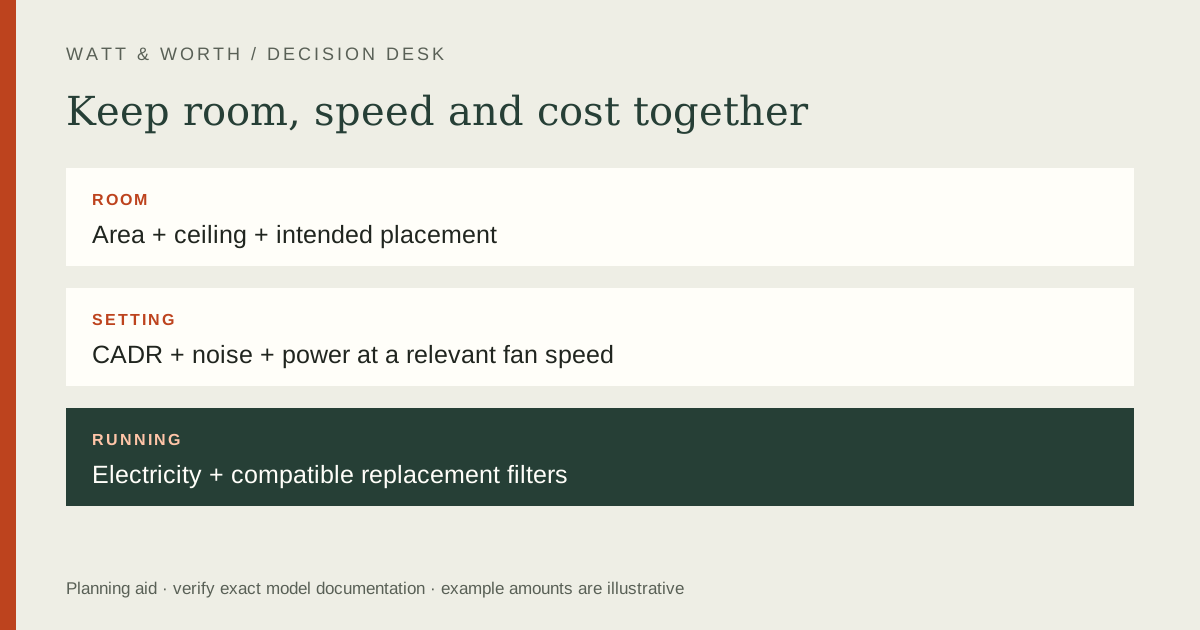
Compare models that provide similar service. A smaller refrigerator might consume less total electricity but fail your storage needs. A large machine bought for rare oversized loads can be a poor everyday fit. Check both absolute energy use and whether the appliance matches the routine you described.
Treat retailer reviews as questions to investigate. A repeated complaint about door clearance suggests checking the dimensional drawing; it does not establish a measured defect rate. This site does not manufacture test scores, reliability statistics or customer testimonials.
Make the final choice reviewable
Write one sentence explaining the decision: “We chose this model because it fits the opening, handles our ordinary loads and has the lower planned cost over our assumed period.” Attach the documents that support it. If the explanation depends on a feature you have not confirmed, return to the shortlist.
Before payment, search the exact identity in CPSC's recall resources and save the return terms. If an installation needs electrical, gas or plumbing changes, obtain qualified local advice. A shopping comparison is not permission to improvise a connection.
Keep one fallback option if delivery fails. Ask whether a substitution needs your approval and whether the quoted installation price changes with a different model. Do not let a last-minute replacement bypass the requirements you already established.
A final practical check
For a complete category review, continue with the dishwasher worksheet, air-cleaner comparison and EnergyGuide guide. Keep the final comparison to products you could actually install. Write down which requirement eliminates each rejected option. That small record prevents a later sale promotion from returning an unsuitable model to the shortlist without new evidence. If household needs change, revise the requirements first and repeat the same process.
Frequently asked questions
Should I compare only one brand?
You can begin with any brand, but use the same requirements and cost basis for every candidate. Brand familiarity does not replace checking the exact model, available service and seller terms.
Is the cheapest purchase always the best value?
No single rule covers every household. A higher purchase price may be justified by a necessary feature or lower documented operating cost. It may also remain more expensive throughout your planning period.
What should I do next?
Read the relevant refrigerator guide, washer guide or dryer guide. Then use the purchase checklist to identify unanswered questions.
Sources
- FTC EnergyGuide explanation — label interpretation and shopping measurements.
- ENERGY STAR Product Finder — model-specific efficiency information.
- CPSC recalls — product safety notices.