Front-load vs. top-load washers: compare the whole laundry routine
Decide between washer types by access, load habits, space, water and energy data, with a worksheet for installation and ownership costs.
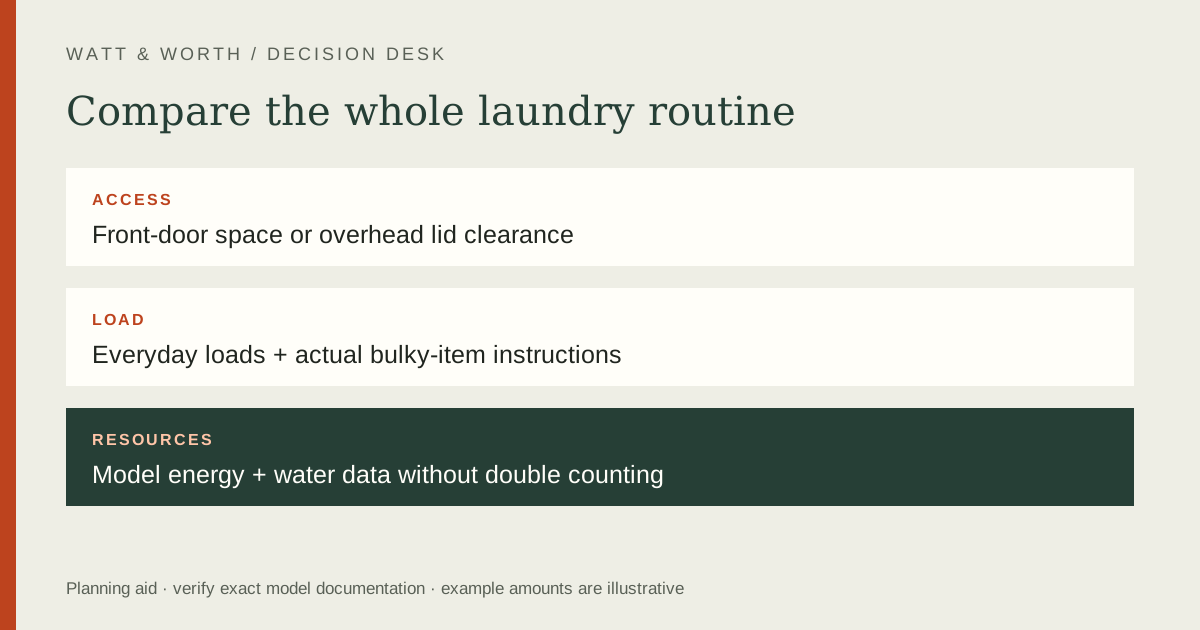
A useful front-load versus top-load washer comparison starts with access and your normal loads. Check where the door or lid opens, whether every user can reach the drum, and what your laundry space permits. Then compare model-specific energy and water information. A machine that saves a resource but does not suit your routine may be an awkward purchase.
Describe an ordinary laundry week
List the loads you actually wash: everyday clothing, towels, bedding and delicate items. Note which tasks are frequent and which happen only occasionally. Avoid buying around one rare oversized item without checking whether ordinary loads will still be manageable.
Capacity numbers are a starting point. Read the manual's loading instructions and restrictions for bulky articles. A large drum does not mean every bulky item is suitable. If you rely on a particular care cycle, verify what the cycle does and which fabrics the instructions permit.
Observe the current bottleneck. If drying is slow, replacing only the washer may not address the whole problem. If the room is cramped, the door position may matter more than a small difference in nominal capacity. Decide which problem the new appliance is supposed to solve.
Compare access, layout and maintenance
| Question | Front access | Top access |
|---|---|---|
| Loading space | Needs room in front of the door | Needs room above the lid |
| Reach | Check bending or a suitable pedestal | Check reach to the drum bottom |
| Stacking | Only an approved model combination and kit | Usually evaluate a different space plan |
| Routine care | Read gasket and dispenser instructions | Read tub and dispenser instructions |
| Counter use | Verify permitted installation above it | Lid opening prevents that arrangement |
Treat this as a room-planning worksheet rather than a category score. Features and installation options differ by model. Never stack units just because they have similar dimensions; confirm the manufacturer's approved pairing and hardware.
Ask all regular users to try the loading motion. Consider the height after any pedestal or stack is added. Controls that look accessible in an isolated showroom unit may be out of reach once installed. Include detergent handling and filter access in that check.
Use efficiency information correctly
ENERGY STAR's washer page explains Integrated Modified Energy Factor and Integrated Water Factor. Use those definitions when reading the Product Finder rather than guessing that every larger number is better. Also record the annual use figures and the assumptions behind them.
A washer's published energy information can account for more than the electricity at the washer's plug. Read the label and documentation before combining it with a separate water-heating or dryer estimate. Otherwise, a spreadsheet can count the same energy twice and overstate savings.
For water cost, use a documented gallons-per-load figure for a relevant cycle when available and your expected number of loads. Multiply gallons by the local combined water and sewer rate on a matching unit basis. Bills may use units other than single gallons; convert carefully and keep fixed charges separate.
Include the work around the machine
An installed quote should identify required hoses, shutoff access, drain arrangements, electrical connection, any approved stacking kit and removal. Ask whether a pedestal, pan or other item is required by the actual site or is simply an optional purchase. A local installer can assess requirements the sales listing cannot.
Illustrative example: Machine A costs $700 plus $180 in installation and accessories. Machine B costs $850 plus $130. Their initial totals are $880 and $980. If documented annual operating estimates differ by an assumed $25, B's extra $100 requires four years of those savings to recover. Repairs and financing are outside that simplified comparison.
Do not assign a precise value to time saved unless the underlying cycle and your routine support it. A shorter advertised cycle may have load-size limits. Compare the cycle you will actually use, including any extra drying or rewashing needed in your own circumstances.
Check delivery and first use
Measure the delivery route and the installed depth with hoses and door clearance included. Ask the delivery team which preparations it needs and who will complete commissioning. Follow the manual for shipping restraint removal and first-use procedures; a shopping guide cannot replace model-specific instructions.
Inspect the unit and retain the serial number, receipt and warranty. Ask how to report damage or a machine that does not work on arrival, and get the seller's deadline in writing. A manufacturer warranty and a seller's return policy answer different questions.
If vibration or movement appears after installation, contact the installer rather than assuming it proves a particular washer type is defective. Floor conditions, leveling and setup need assessment. Stop use if the instructions or the installer identify a safety concern.
A final practical check
When comparing controls, look at the sequence needed for a normal load rather than counting available programs. Can the regular users select the intended cycle and recognize when it has finished? Check whether settings persist between loads and whether an app is necessary for a function you need. These usability questions are especially useful when several people share the laundry. A routine that is easy to repeat may matter more than a long list of unfamiliar cycle names.
Frequently asked questions
Is one washer type always more efficient?
Compare exact models and the relevant metrics, not just the door arrangement. ENERGY STAR provides category guidance, but capacity, cycle choice and household use affect a real comparison.
Should I replace the dryer at the same time?
Only if there is a practical reason. Check capacity, compatibility and installation if keeping the current dryer. A matching appearance alone does not establish an economic benefit.
Which guides should I use with this one?
Use the buying framework, the dryer comparison and the EnergyGuide guide. The ownership calculator can organize your final costs.
Sources
- ENERGY STAR clothes washers — efficiency metrics, capacity and buying guidance.
- FTC EnergyGuide explanation — reading energy estimates.