How to compare dishwashers beyond the advertised place settings
Choose a dishwasher by real dish fit, opening dimensions, drying options, energy and water documentation, and a complete installation estimate.
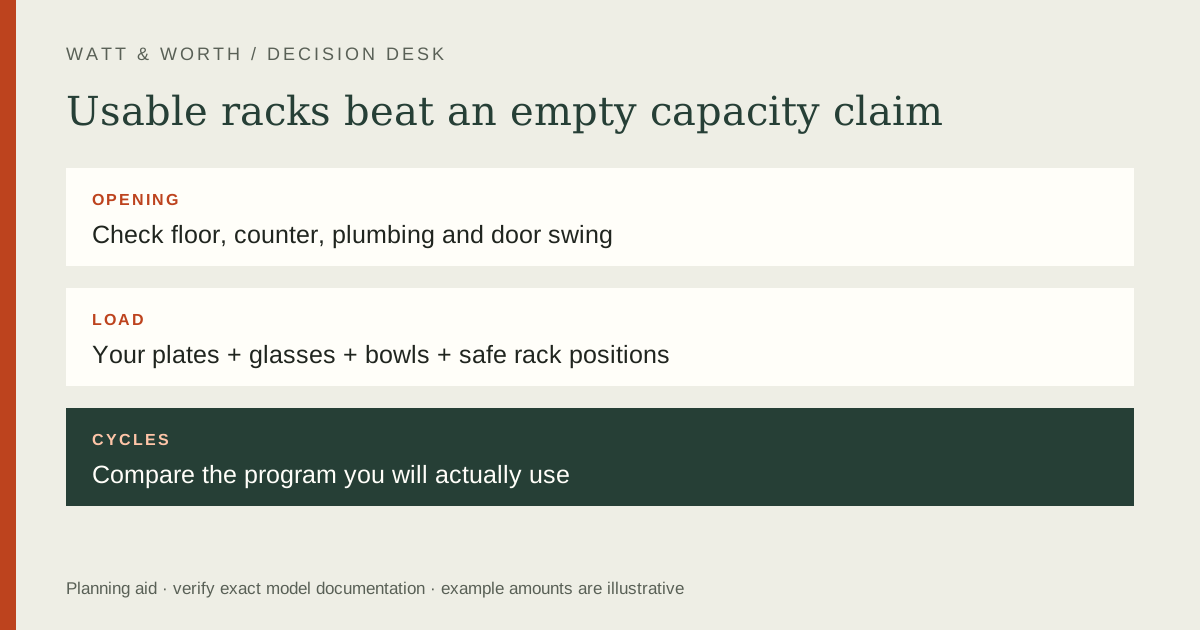
Compare dishwashers by loading your actual dishes, checking the installation opening and reading the cycle instructions. A large place-setting figure does not prove that your tall glasses or deep bowls fit well. Once the machine meets those needs, compare documented water and energy use and the installed total rather than the shelf price alone.
Check the cabinet opening carefully
Measure the opening at its narrowest and lowest points. Finished flooring, counter supports and adjacent trim can affect removal of the old unit and installation of the new one. Ask an installer to assess a tight fit before ordering, especially if floors or counters have changed since the existing machine was installed.
Save the exact model's dimensional drawing. Include door opening and handle projection in the walkway plan. Check that nearby drawers, cabinet doors and the refrigerator can still be used. A dishwasher door that opens into the main passage may change the kitchen routine more than you expect.
Confirm the intended water, drain and electrical arrangement with the installer. Connection requirements and local rules are not interchangeable between homes. A countertop or portable option has its own compatibility questions; do not assume it can attach to every faucet or outlet.
Test the racks with a realistic load
Bring measurements of a dinner plate, tall glass, wide bowl and frequently used pan. Inspect how they fit with the racks in different positions. Check whether moving the top rack reduces useful space below or interferes with a spray arm.
| Feature | Useful question | Possible tradeoff |
|---|---|---|
| Adjustable upper rack | Can tall glasses fit securely? | Lower-rack clearance can change |
| Third rack | Does your cutlery fit the slots? | It occupies vertical space |
| Folding tines | Will a frequently used bowl sit safely? | Flexible space is only useful if stable |
| Compact format | Does it fit your available opening? | More loads may be needed |
| Drying options | What does the chosen cycle require? | Energy, time and dish material differ |
The goal is not to maximize the number of listed features. It is to find a repeatable loading pattern for your household. Read the instructions for dishwasher-safe materials and arrange a realistic mix of items rather than judging an empty rack.
Compare cycles, water and energy
ENERGY STAR's dishwasher guidance discusses capacity, cycle choices and energy labels. Use model-specific data and note the cycle or standardized assumptions behind it. A quick cycle and an economy cycle may serve different loads; compare the routine you are actually willing to use.
Do not add a label's estimated total annual operating cost to separate electricity and water calculations without checking what it already includes. Build one consistent method. Either use a documented complete estimate with its limitations, or calculate each resource separately on matching units.
Illustrative water calculation: an assumed difference of 1 gallon per load over 250 loads is 250 gallons a year. At an illustrative combined variable water and sewer rate of $0.015 per gallon, that part of the difference is $3.75 per year. This is not a product claim or a local tariff; it shows why unit conversion and actual load frequency matter.
Put installation and accessories in writing
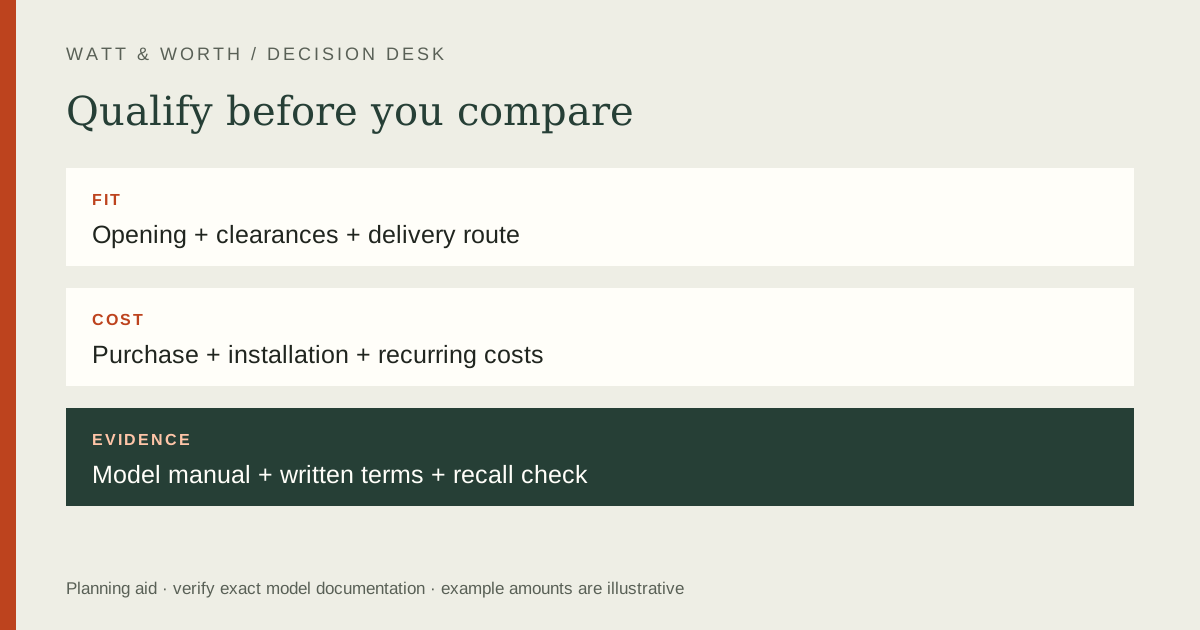
Ask whether the quote includes the connection kit, power arrangement, delivery, installation, removal and any required site work. A seller may offer delivery without installation, and an installation service may exclude unsuitable existing connections. Clarify those distinctions before choosing a delivery date.
Illustrative comparison: a $650 listing plus $220 of required work totals $870, while a $720 listing plus $110 totals $830. If taxes are not already included, add the applicable amount using the seller's quote. Lower purchase price alone would point to the wrong option in this example.
Check panel-ready requirements if matching cabinetry is important. A decorative panel and its hardware may be separate from the appliance. Ask who supplies, fits and adjusts it. Keep appearance decisions separate from assumptions about cleaning performance or energy use.
Consider the daily friction before buying
Check control visibility, the force needed to open the door and whether the racks move comfortably when loaded. If a household member has limited reach or grip, evaluate the machine in the configuration it will have at home. Do not rely on a photograph of an empty, elevated display.
Noise claims require context. Read which rating is being shown and whether comparable documentation exists for the alternatives. We have not measured these machines, so this guide does not translate marketing descriptions into invented quietness scores.
Read the care instructions for filters and spray arms. Identify whether the proposed installation permits ordinary access. A maintenance routine you can follow is more useful than a feature you will leave unused. If a connected function is included, verify whether normal washing still works without an account or network.
A final practical check
Check the detergent and rinse-aid instructions for the exact machine and intended cycle. Keep any recurring product assumptions consistent between candidates. If you already own a large supply, do not assume it is appropriate without reading the manual. Ask about filter access and cleaning before accepting an installation that makes routine care awkward. The best loading layout is one you can maintain and use repeatedly, rather than a display arrangement that only works when the machine is empty.
Frequently asked questions
Should I choose a compact dishwasher to save energy?
Only after considering the loads it will require. A smaller machine that needs more cycles is a different usage scenario. Compare documented annual or per-cycle information on a consistent basis.
Is a short cycle the best cycle?
It depends on load size, soil level and the manufacturer's instructions. Verify the intended task instead of treating the shortest time as an overall performance ranking.
What should I read before placing the order?
Use the buying framework, refrigerator guide for shared kitchen clearances, and EnergyGuide guide. Bring the final numbers to the ownership tool.
Sources
- ENERGY STAR dishwashers — capacity, cycle and efficiency considerations.
- FTC EnergyGuide explanation — limits of operating-cost estimates.