Air purifier buying comparison: room fit, CADR and filter cost
Compare room air cleaners using the intended room, documented particle-cleaning capacity, usable fan settings and recurring filter and electricity costs.
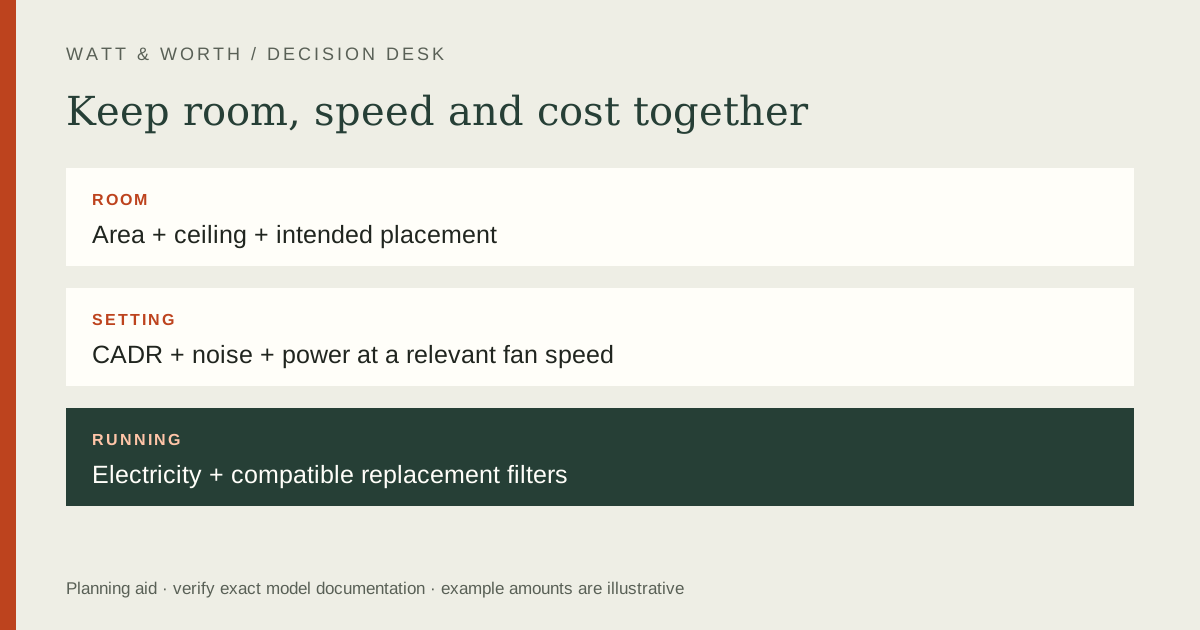
Compare a room air cleaner by matching documented particle-cleaning capacity to the space where you will use it, then checking filter availability and operating cost. A large room-coverage headline does not tell you everything about the test conditions or fan speed. This is a purchasing worksheet, not a medical recommendation or a promise to remove every pollutant.
Define the room and the task
Measure the room's length and width and note the ceiling height. Identify whether the appliance will serve a closed bedroom, an open living area or a home office. Open doors and connected spaces can change the practical setting compared with a simple room-size claim.
Write down the specific task you want the device to perform. Particle filtration and removal of gases are different questions. Do not assume a particle rating establishes odor control or protection against every indoor-air hazard. If there is a source of pollution or a health concern, consult the appropriate EPA guidance and a qualified professional rather than treating a purchase as a complete solution.
Decide where the unit can stand without obstructing access or violating the manual's placement guidance. Check the space around its inlets and outlets. A device tucked behind furniture may not be used in the way its documentation anticipates.
Read the rating with its conditions
ENERGY STAR's air-cleaner page explains Clean Air Delivery Rate, or CADR, and relates sizing to room area. Use the exact model's published information and the assumptions behind it. A retailer's largest room claim may use a different air-change basis from another listing.
| Comparison item | Record this | Ask if missing |
|---|---|---|
| Particle CADR | Metric and tested setting | Which particles and speed? |
| Room sizing | Area and ceiling assumptions | What air-change basis is used? |
| Noise | Documented setting and rating | Is it the same speed as capacity? |
| Energy | Watts or annual kWh with conditions | Does it match intended use? |
| Filters | Exact replacement part | Is supply available locally? |
Avoid combining the highest cleaning-capacity number with the lowest noise or power number unless they refer to the same setting. Those may describe different operating modes. A useful comparison keeps capacity, noise and power together for the speed you expect to use.
Estimate filter and electricity costs separately
Find the replacement filter part number and read the replacement guidance. Distinguish a washable prefilter from a replaceable main filter. If the documentation makes replacement depend on conditions or an indicator, treat a fixed schedule as an assumption rather than a guarantee.
Illustrative example: assume a unit averages 35 watts for 12 hours a day. Annual electricity is 35 × 12 × 365 ÷ 1,000 = 153.3 kWh. At an illustrative $0.20 per kWh, that is $30.66 a year. If your own filter scenario adds $60 annually, the planned running total is $90.66. Neither number is a quote or typical-cost claim.
Use the energy calculator after converting your estimate into annual kWh. Add filters in the ownership comparison. Keep the purchase price separate from running cost so you can see whether a cheaper unit becomes more expensive under your assumptions.
Check controls and maintenance access
Try the fan controls, display dimming and filter access. If it will run in a bedroom, determine whether a setting comfortable for sleep still has suitable documented capacity. If published information is insufficient, leave that comparison unresolved rather than inventing a performance score.
Check whether an app is optional, which controls remain on the unit and what happens after a network outage. A connected feature should solve a task you actually have. Read the software support policy if continued remote operation matters to the purchase.
Ask how the filter indicator works and whether replacement parts require proprietary cartridges. Record the part number in your purchase folder. Availability of a vaguely similar replacement is not evidence of compatibility; follow the manufacturer instructions.
Keep marketing claims within their limits
An energy-efficiency designation is not a medical endorsement. A device can use electricity efficiently without being appropriate for your specific concern. Read the original technical and safety information for any additional treatment technology rather than relying on broad “clean air” wording.
Do not interpret a sensor display as a comprehensive laboratory measurement of room safety. Different sensors detect different things, and the display's meaning depends on the model. Use it as described in the manual, not as a substitute for addressing a known hazard.
Before ordering, save the return terms and inspect the exact listing identity. Filters can be consumables with separate return restrictions, so ask which opened items remain returnable. We do not claim hands-on testing, health outcomes or independently verified pollutant-removal percentages for any product.
A final practical check
If the unit will move between rooms, check its weight, handle and storage requirements as well as room sizing. A device chosen for one room should be reassessed when used in a different space. Keep the original filter instructions and document the replacement part before discarding packaging. If a seller proposes an alternative filter, verify compatibility with the manufacturer rather than assuming that matching external dimensions establish equivalent suitability for the intended appliance.
Frequently asked questions
Is the largest room rating the best choice?
Compare the rating basis, not just the largest number. Also consider the speed you will tolerate, placement and recurring costs. A larger headline can represent different assumptions.
Can the calculator tell me whether a cleaner is effective?
No. It calculates electricity or planned cost from your inputs. Effectiveness requires appropriate product data and a match to the intended task and room.
Where should I go from here?
Return to the buying framework, read energy labels and compare washer ownership questions for another example of keeping resource costs separate.
Sources
- ENERGY STAR air cleaners — CADR, room sizing and buying guidance.
- ENERGY STAR Product Finder — model-specific efficiency records.