How to read an EnergyGuide label without mistaking it for your bill
Use the yellow EnergyGuide label to compare similar appliances, understand annual energy estimates and apply your own utility rate.
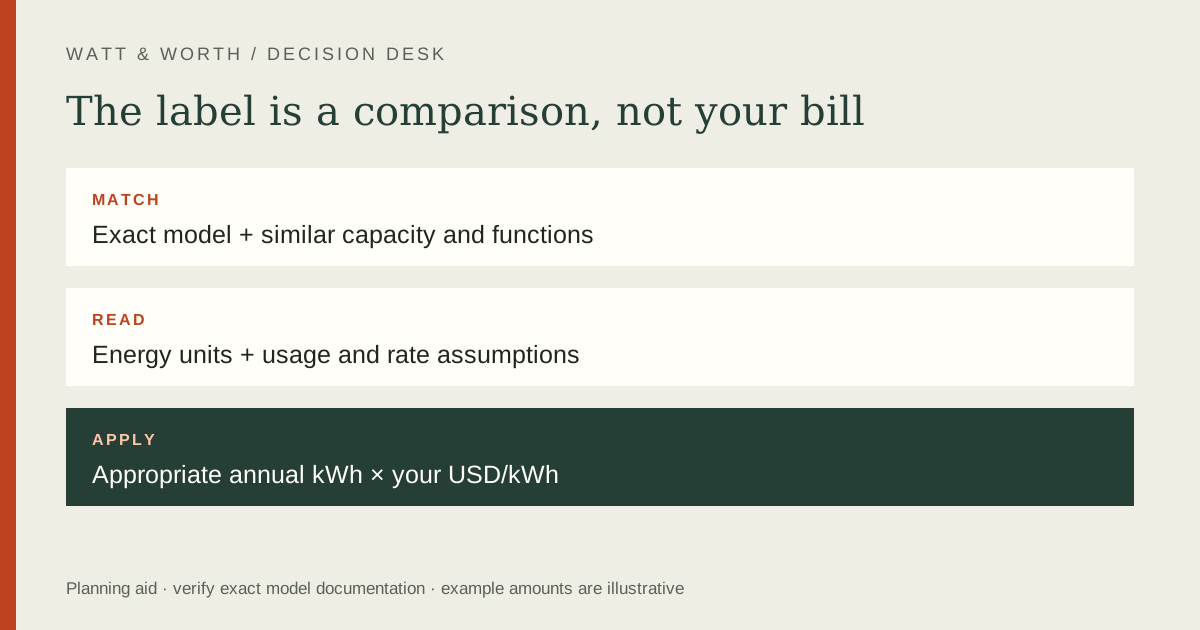
Use an EnergyGuide label as a standardized comparison aid, not a personal bill forecast. Confirm the exact model, compare similar capacity and functions, and read which fuel and usage assumptions appear on the label. The annual dollar estimate is only one part of owning the appliance. Purchase, installation and maintenance still belong in the decision.
Confirm that the label belongs to the model
Check the full model identity against the listing and the unit you plan to order. Retailer pages sometimes show multiple variants together. Save the model-specific label from the manufacturer or seller rather than relying on a photograph that may represent the product family.
Read the identifying information and comparison range before focusing on the prominent dollar amount. The relevant comparison is between products doing a similar job. A label is less informative if one candidate is a different size or has functions you do not need.
If a label is not visible in the store, ask for it or check the manufacturer documentation. Do not replace missing information with a guessed value from a different model. Keep the missing figure marked as unknown in your shortlist until a reliable record is available.
Separate the energy amount from the dollar estimate
The FTC explains that the operating-cost figure uses assumptions about typical use and energy price. Your actual bill can differ. Annual energy use and the assumed rate help you understand the calculation; a large printed dollar number should not be treated as a quote from your utility.
| Label or worksheet item | What to do with it | What it does not establish |
|---|---|---|
| Model identity | Match the exact candidate | All variants are identical |
| Annual energy amount | Record units and conditions | Your actual annual consumption |
| Estimated annual cost | Read the rate and use assumptions | A guaranteed bill |
| Comparison range | Check the product grouping | Overall product quality |
| Efficiency designation | Verify program information | Reliability or service quality |
For an electricity-only calculation, multiply annual kWh by dollars per kWh. If the product uses another fuel or the label combines energy assumptions, do not force the entire label into a simple electricity field. Preserve the original units and seek the appropriate model data.
Recalculate a scenario using your own rate
Find the variable charges on your utility bill and determine which rate applies to additional use. Fixed account charges usually do not change because you replace one appliance, so adding them to both models can obscure the difference. Time-of-use or tiered plans need a more careful estimate than a single average rate.
Illustrative example: Model A is assumed to use 500 kWh per year and B 400 kWh. At an illustrative $0.18 per kWh, the annual estimates are $90 and $72, a difference of $18. At $0.30 per kWh, the difference becomes $30. These numbers demonstrate rate sensitivity, not any current model or utility tariff.
The energy calculator performs that multiplication. Record where each input came from. If you adjust annual use for your household, retain both the original model figure and your assumption so you do not later mistake the adjustment for a manufacturer claim.
Keep EnergyGuide and ENERGY STAR distinct
EnergyGuide and ENERGY STAR answer different questions. Consult the FTC's explanation of the yellow label and the current ENERGY STAR Product Finder for the model you are considering. Neither should be turned into a single score for every aspect of an appliance.
You still need to evaluate controls, usable capacity, installation, maintenance, warranty and local service. A model with appealing energy data can fail an essential fit requirement. Conversely, two models with similar energy amounts may differ in ways that matter to your household.
Avoid assuming a certification alone qualifies a purchase for every rebate. A program may require an eligible model, participating seller, particular installation or application timing. Check the actual program terms before subtracting money from your purchase budget.
Use the information in a full cost comparison
Once you have a consistent annual operating estimate, combine it with installed cost over an explicit planning period. Keep the period an assumption rather than a claimed appliance lifespan. Add recurring consumables only once, and identify costs not included in the calculation.
Illustrative example: paying $180 more for an assumed $18 annual electricity saving gives a ten-year simple payback. That does not mean the purchase is good or bad by itself. A shorter stay in the home, financing charges or a useful feature can change the decision.
Do not attach false precision to a rough estimate. A worksheet showing cents is convenient arithmetic, but it does not prove your inputs are accurate to the cent. The important question is whether reasonable changes to the assumptions alter which option you prefer.
A final practical check
When sharing a shortlist with another person, include a photograph or file of each original label beside your recalculation. This makes disagreements easier to resolve: you can tell whether the issue is the model data, the chosen tariff or the expected use. If one label includes a different fuel assumption, stop and align the methods before comparing the totals. A consistent worksheet is more useful than a larger collection of figures that describe different things.
Frequently asked questions
Can I compare the dollar figures directly?
Only after checking that the model grouping, energy assumptions and rate basis are comparable. Applying your own consistent rate to appropriate model data often makes the comparison clearer.
Does lower kWh always mean the better appliance?
It means less electricity in the stated scenario. It does not prove that the model provides the capacity, performance or installation compatibility you need.
Which product guide should I read next?
Use the buying framework, then the relevant refrigerator comparison or dishwasher guide. Add purchase costs with the ownership tool.
Sources
- FTC EnergyGuide explanation — what the label means and why your bill can differ.
- ENERGY STAR Product Finder — check model-specific program records.