Refrigerator comparison: layout, usable space and energy cost
Compare refrigerator layouts using door clearance, usable shelves, installation needs and annual energy data rather than capacity alone.
Choose a refrigerator layout by checking how its doors and storage work in your kitchen before comparing features. Nominal capacity, a polished finish and a low advertised energy estimate do not establish that the refrigerator will fit your opening or hold the things you buy. Compare exact models after drawing the available space and listing the storage you use every week.
Start with the opening and the people using it
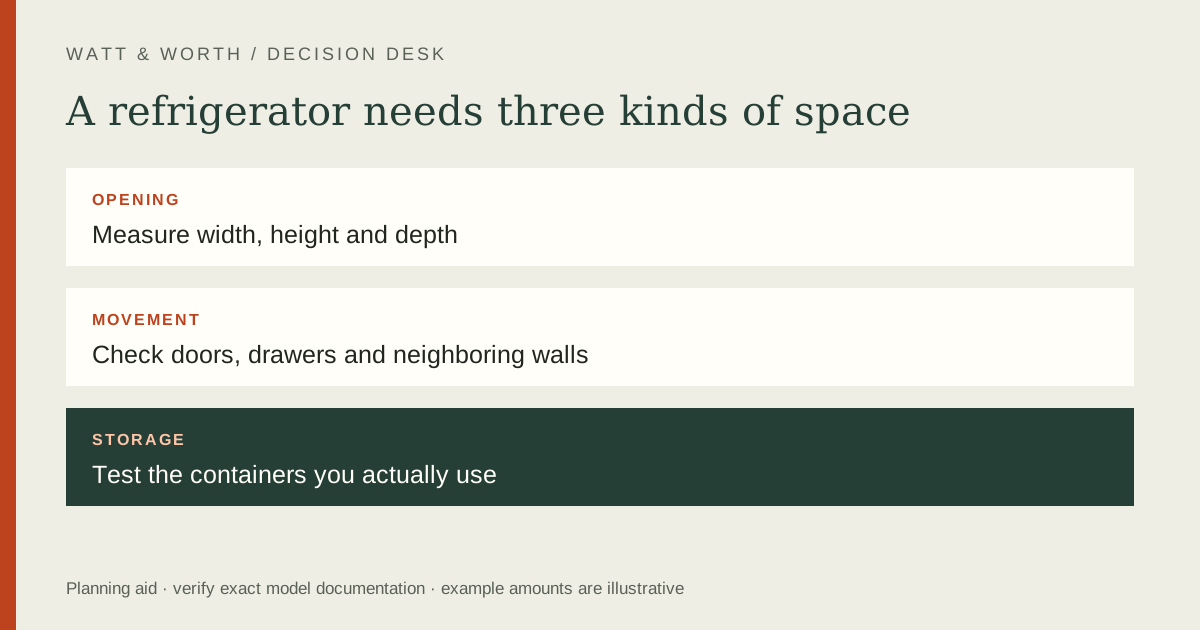
Measure width, height and depth at more than one point. Include nearby walls, baseboards, hinges, cabinet overhangs and the counter edge. Then find the clearance drawing in the exact model's installation manual. The manufacturer's requirements control; there is no universal gap suitable for every refrigerator.
Door-open dimensions matter as much as closed dimensions. A door that opens enough to reach a carton might still prevent removal of a drawer. Check whether handles project into a walkway and whether the hinge side is beside a wall. Ask the delivery team about approved handling if the route is tight.
Try the storage positions you will use. Someone who wants fresh food at eye level may value a lower freezer. Someone who freezes many small items may prefer a different arrangement. Include the reach and strength of all regular users rather than assuming one layout is easier for everyone.
Compare the layouts on their actual tradeoffs
| Layout | Practical question | Detail to verify |
|---|---|---|
| Top freezer | Is lower fresh-food access comfortable? | Shelf reach and freezer organization |
| Bottom freezer | Can you manage loaded freezer drawers? | Drawer extension and usable compartments |
| Side by side | Do tall narrow sections suit your groceries? | Width for trays and large containers |
| French door | Will divided doors help your walkway? | Wall clearance and drawer access |
| Counter depth | Is a shallower body worth the storage tradeoff? | Overall depth including handles |
These are questions to test, not promises about every model. “Counter depth” does not mean flush with every cabinet. Compare the dimensional drawing and usable storage, not the category name alone.
Take measurements of one awkward item, such as a serving tray or meal-prep container. In a showroom, use a clean paper outline or tape measure with permission. Check whether a shelf can be repositioned without losing another space you need. Shelves that look spacious when empty can be less flexible with real containers.
Build the full installation quote
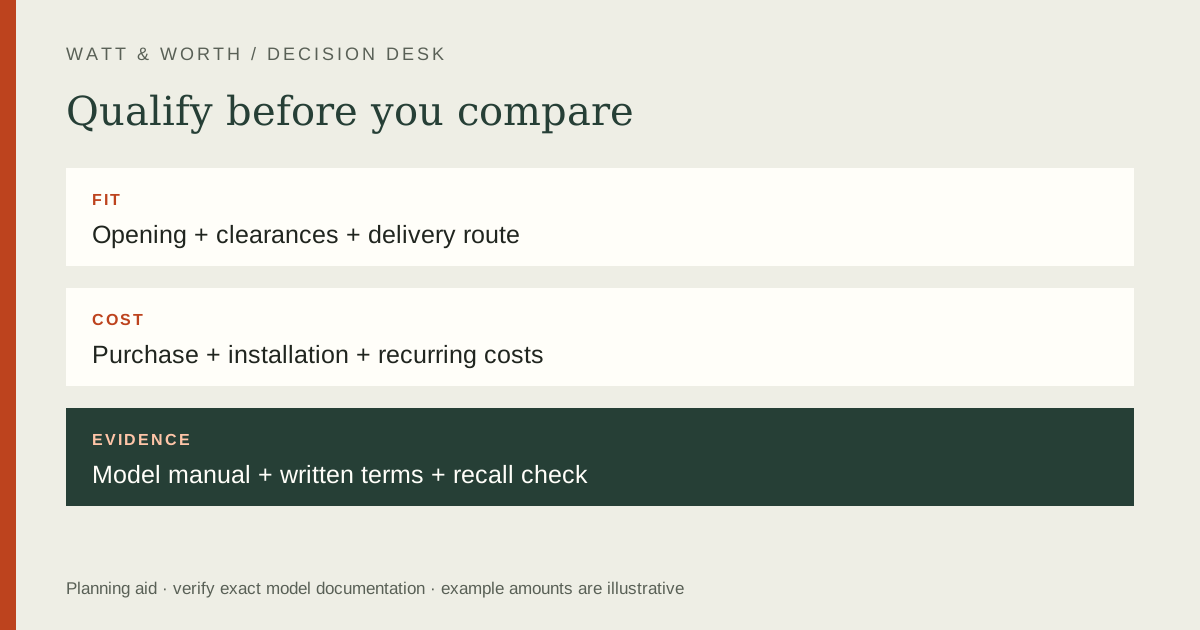
Ask whether delivery includes moving the refrigerator into its final location, leveling, connecting water and removing packaging. If an ice maker or dispenser is present, identify who supplies and connects the required line. Ask an installer about an unsuitable or missing connection before ordering.
Separate required work from optional convenience. A dispenser may introduce filters and additional maintenance. An appliance without that feature may meet the household's needs with fewer recurring purchases. Do not assume a more complex feature package is a benefit simply because it is included in a promotion.
Illustrative budget: a $1,100 refrigerator, $80 delivery, $120 installation and $50 haul-away totals $1,350 before any tax not already included. A $1,200 competing listing with those services included could be cheaper on that basis. These amounts demonstrate the worksheet; obtain actual written prices and tax treatment from the seller.
Compare energy on equal terms
Record annual kWh from the exact model's documentation. Compare similar capacity and functions, then apply your own electricity rate. ENERGY STAR's refrigerator guidance and Product Finder are useful starting points for checking efficiency information, but your installation conditions and use still matter.
Illustrative example: a difference of 100 kWh per year at $0.20 per kWh equals $20 per year. Paying an extra $300 solely for that difference gives a simple $300 ÷ $20 = 15-year recovery period. This is arithmetic, not a prediction that either model lasts fifteen years.
If your decision changes with a small variation in the assumed rate, note that sensitivity. The energy calculator helps with electricity arithmetic, while the ownership comparison includes the purchase and installation figures. Water filters and repairs belong in a separate allowance unless you have documented amounts.
Avoid common shortlist errors
Do not assume all finishes share the same dimensions or model identity. Confirm the full model suffix on the order. Keep a copy of the specification sheet that informed your measurements. If the seller changes the model at delivery, recheck the fit before accepting the substitution.
Ask about the intended installation environment. A secondary refrigerator in a garage needs a model whose published operating conditions match that space. Do not infer suitability from appearance or a general efficiency label. A conditioned kitchen and an unconditioned outbuilding present different requirements.
Plan old-unit removal before the new one arrives. Clear stored food, arrange appropriate temporary storage and ask the removal service what preparation it requires. Do not attempt refrigerant handling yourself. The seller or local waste program can explain the route available in your area.
A final practical check
Before choosing a finish, check the lighting and adjacent surfaces in the actual room. An appearance preference can be a valid reason to choose one qualifying model, but keep it separate from a claimed financial saving. Also ask whether display doors and shelves match the configuration being sold. A showroom arrangement with optional accessories should not be assumed to represent the delivered unit. Record every included accessory that affects usable storage or installation.
Frequently asked questions
Should I buy the largest refrigerator that fits?
Only if the storage is useful to you. Excess capacity is not automatically value, while insufficient capacity can create daily frustration. Compare a realistic grocery load and shelf layout before deciding.
Does an efficiency label guarantee a lower bill?
It supports comparison under stated conditions. Actual electricity cost depends on energy use and your rate, and it does not include the purchase price or every maintenance expense.
Where does this fit in a wider purchase plan?
Return to the buying framework for the complete shortlist method. Read EnergyGuide labels and the dishwasher comparison when planning a kitchen purchase together.
Sources
- ENERGY STAR refrigerators — sizing and efficiency buying guidance.
- FTC EnergyGuide explanation — estimate limitations and measurement reminders.