Open-box and refurbished appliances: compare the specific unit
Assess an open-box or refurbished appliance using its exact identity, condition, included parts, warranty, return terms and complete ready-to-use cost.
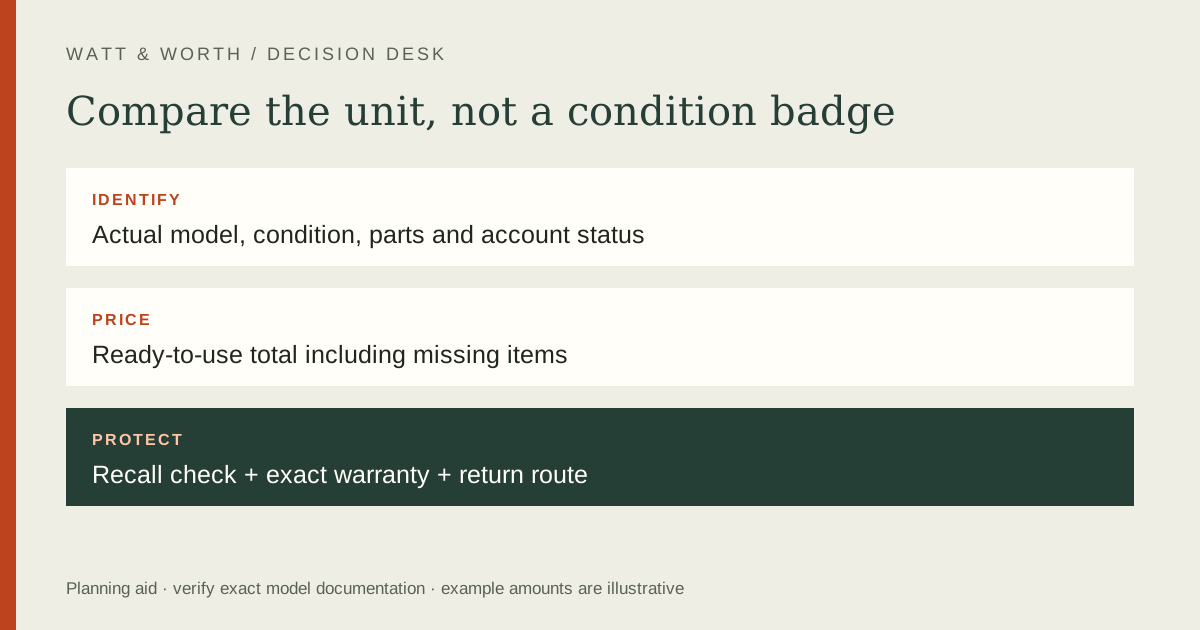
Compare an open-box or refurbished appliance as a specific unit with its own condition and terms, not as a discounted copy of a new listing. Verify the model, included parts, reason for the condition label, warranty and return route. A lower price can be useful, but only if the machine can be safely installed and performs the job you need.
Ask what the condition label means
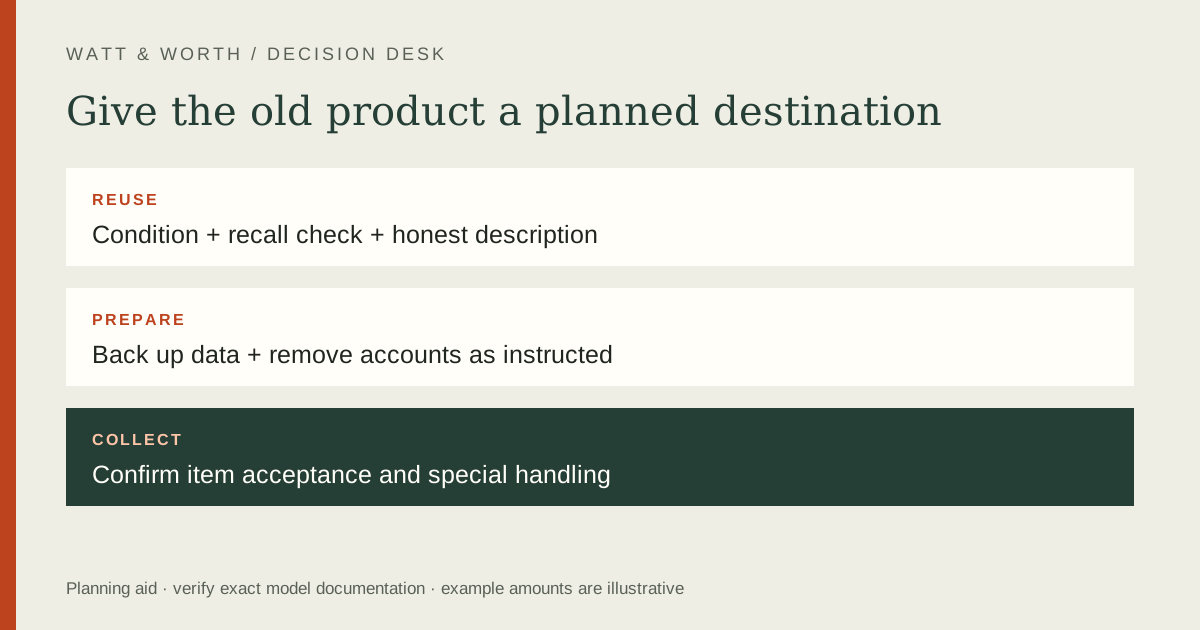
Terms such as open box, scratch and dent, refurbished or renewed need a seller's definition. Ask whether the unit was used, repaired, displayed or returned and what inspection was performed. Do not assume the label represents a standardized test or a particular repair history.
Request photographs of the actual unit when buying remotely. Look for the exact identity plate and visible damage, while protecting private information. A stock image cannot establish condition. If the seller cannot show the unit or identify it accurately, keep that uncertainty central to the decision.
Ask about missing accessories and packaging. A small missing bracket, cord, hose or shelf can change ready-to-use cost or delay installation. Verify replacement compatibility through the manufacturer rather than assuming a visually similar part is adequate.
Separate cosmetic issues from functional questions
| Area | What to inspect or ask | Why it matters |
|---|---|---|
| Identity | Full model and serial information | Compatibility and recall matching |
| Cabinet and doors | Actual photos and alignment | Fit, access and possible damage |
| Internal parts | Shelves, racks, filters and accessories | Complete usable configuration |
| Connections | Qualified inspection where needed | Safe installation and scope |
| Controls | Demonstration within safe seller procedures | Basic function and account access |
Do not diagnose internal safety from an exterior photograph. A scratch may be cosmetic, but a seller's reassurance cannot replace an appropriate assessment of damaged connections or uncertain repair work. Avoid purchases whose essential condition cannot be verified.
For connected products, confirm that previous accounts and management locks can be removed through legitimate procedures. Ask whether the device can be set up for a new owner and whether the app and required service remain supported. Do not buy a locked device on the assumption that a workaround will solve it.
Compare the true ready-to-use price
Add the purchase price, tax, delivery, installation, missing parts and any required service. Compare that total with a new option that meets the same needs. Keep return transport and restocking exposure visible if the seller's terms make them your responsibility.
Illustrative example: a $500 open-box dishwasher plus $90 in missing parts and $200 installation totals $790 before any additional tax. A complete new alternative at an assumed $820 installed differs by only $30. The decision then depends heavily on actual condition and terms, not the original discount headline.
Do not invent the original selling price or a percentage saving. Use a current written comparable offer if you want to show the difference. A high crossed-out price is not enough to establish that the unit is good value today.
Verify protection before collection
Read the seller return policy and any warranty for the exact condition category. Ask whether coverage is from the manufacturer, refurbisher or seller, and whether it includes labor or transport. Confirm transferability rather than assuming the original new-product warranty applies.
FTC warranty guidance helps identify coverage questions, but state rights and “as is” terms need context. If legal protections determine whether you can afford the risk, consult your state consumer protection office or qualified adviser. Do not rely on a general guide as a ruling on your sale.
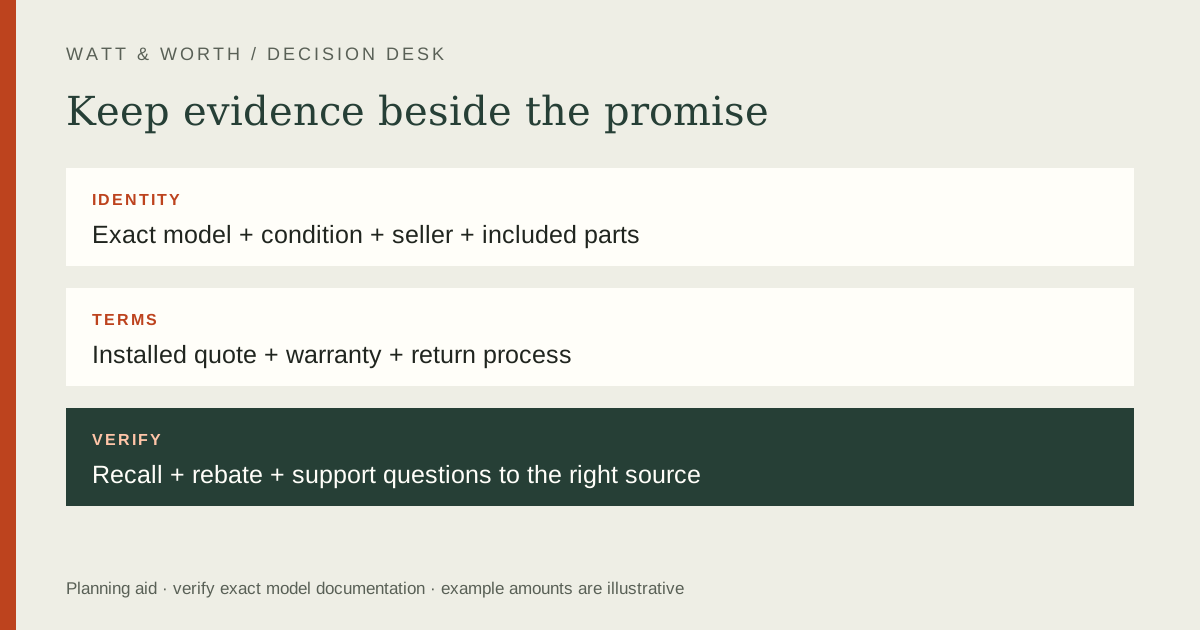
Search CPSC recalls using the exact product identity. If a notice may apply, match model, serial range and other identifiers and follow the official remedy route. A seller's claim that a product was repaired should be checked against the actual notice and documented remedy where relevant.
Plan inspection and delivery together
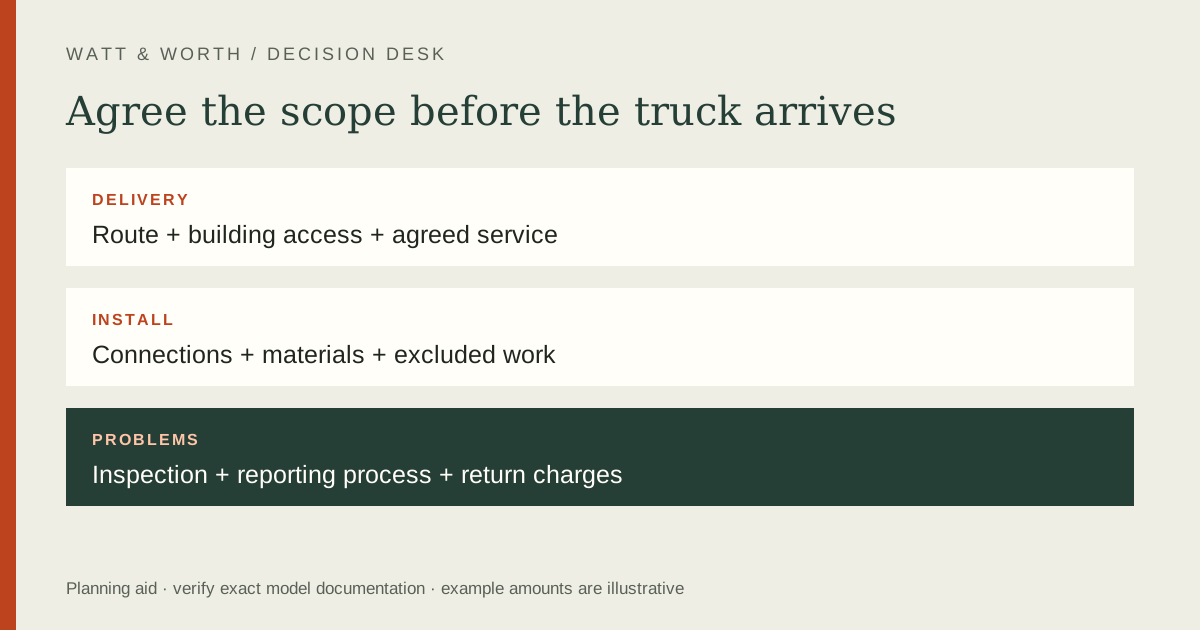
Arrange an opportunity to inspect before acceptance if the seller permits it. Confirm how a remotely purchased unit's condition is documented and how discrepancies must be reported. Keep the listing, actual photographs and written answers in one folder.
Measure the opening and delivery route just as you would for a new appliance. A discounted unit does not reduce the need for model-specific clearance or an appropriate installer. Ask who is responsible if the product cannot be installed in the agreed site.
After purchase, retain the receipt and identity records and follow the manual for first use. Do not interpret a brief demonstration as proof of long-term reliability. We do not inspect individual units or assign refurbished-product quality scores.
A final practical check
If inspection is possible only at collection, agree in advance what happens if condition differs from the description. Ask whether payment or transport arrangements can be reversed and which charges remain. Do not travel with an unsuitable vehicle or improvise moving equipment simply because the unit is discounted. A legitimate delivery or collection plan belongs in the ready-to-use total. Keep the seller identity and written condition statement available until inspection and installation are complete.
Frequently asked questions
Is an open-box appliance always unused?
Do not assume that. Ask the seller to define its condition category and describe the specific unit's history and inspection. Save the answer with the order.
How large should the discount be?
There is no universal percentage. Compare complete ready-to-use cost, verified condition and protection against a suitable new alternative. The remaining uncertainty may outweigh a small saving.
What should I check next?
Use the evidence checklist, read warranty terms and perform a recall check. Review delivery and returns before arranging collection.
Sources
- CPSC recalls — exact product safety notices and remedies.
- FTC warranties — written coverage and used-product questions.