Replacing appliances and electronics: plan removal, data and recycling
Prepare old appliances and electronics for an appropriate local collection route, with account removal, data checks and careful battery and refrigerant handling.
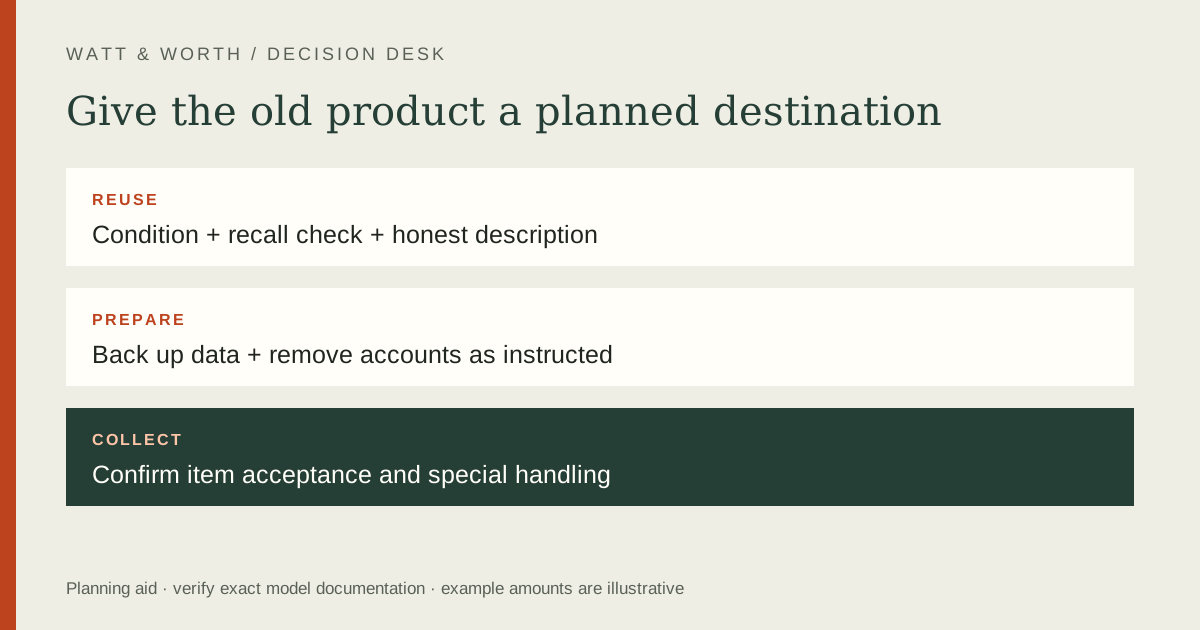
Plan the old product's destination before the replacement arrives. Confirm whether the seller's haul-away service includes appropriate handling, or use a local program that accepts the exact item and condition. For electronics, protect your data and accounts. Batteries and refrigerant-containing appliances need particular care; this guide is not a dismantling or hazardous-material handling procedure.
Decide whether the item can remain in use
If the product still works, consider whether repair, continued use or a suitable donation is practical. Check relevant safety notices before selling or giving it away. A product with an unresolved recall should follow the official notice's remedy process rather than an ordinary resale plan.
Describe condition honestly to any recipient. Include model identity, missing parts and known limitations. Do not give a safety assurance based solely on a successful power-on test. If you cannot establish that a transfer is appropriate, ask the relevant program or manufacturer for guidance.
For a replaced refrigerator or freezer, keeping it as a second unit also creates ongoing use and cost. Compare whether you truly need that service. Do not assume that moving an old appliance to a garage creates a suitable installation; check the model's permitted environment.
Verify the collection route
| Item or issue | Ask the collection service | Avoid assuming |
|---|---|---|
| Large appliance | Accepted type, preparation and pickup scope | Every delivery includes removal |
| Refrigerant-containing unit | Appropriate handling and local process | DIY refrigerant removal is acceptable |
| Computer or connected device | Data and account preparation | Collection automatically erases data |
| Battery-containing device | Accepted condition and handling instructions | Ordinary recycling bins are suitable |
| Damaged equipment | Whether special arrangements are needed | Normal drop-off rules still apply |
Use the local solid-waste program, utility or seller to identify a current route. Programs can vary by location, item and condition. Confirm fees, appointment requirements and whether someone must be present. A national directory is a starting point, not proof that a particular facility accepts your unit today.
Ask what documentation the service provides if you need a record of collection. Keep the actual receipt rather than describing an unverified destination as certified recycling. We do not endorse a collection company or claim a chain of custody we have not checked.
Protect data before giving up electronics
Back up information you need and verify that the backup can be accessed. Follow the manufacturer's current instructions for removing accounts, activation locks and personal data. A generic factory-reset description may not cover every device or storage configuration.
For a work or school-managed device, ask the organization about its return and data rules. Do not remove management controls through an unauthorized workaround. If you are uncertain about sensitive storage, obtain appropriate technical assistance before transfer.
For connected appliances, remove the product from the relevant account and follow the resale or disposal instructions. Keep the model and serial record for your own purchase folder while avoiding sharing passwords, recovery codes or unrelated household information.
Handle batteries and appliances through the right process
EPA's electronics recycling guidance says lithium-ion batteries and devices containing them should not go into household garbage or ordinary recycling bins. Check the appropriate local collection instructions. Do not puncture, crush or dismantle a device to remove a battery that is not intended for safe user removal.
If a battery is damaged or a device shows signs of a hazard, ask the collection program or manufacturer for specific handling guidance. Do not assume standard shipping or drop-off instructions apply to damaged items. This site does not provide a repair or hazardous-shipping procedure.
For refrigerant equipment, use an appropriate service and local process. Do not cut lines or attempt to recover refrigerant yourself. Ask who performs disconnection and what preparation is required, especially when electrical, plumbing or gas connections are involved elsewhere in the removal project.
Include removal in the replacement budget
Illustrative comparison: one seller quotes $1,000 for an installed replacement plus $60 removal, while another quotes $1,030 including removal. On those assumed terms, the second total is $30 lower. Verify what each removal service actually includes before treating the packages as equivalent.
Coordinate timing so the old unit is ready under the service's instructions and the new one can be installed. Ask about stairs, elevator access and whether the crew can remove an oversized item through the available route. Do not leave that question until the truck arrives.
Save the collection record and remove the old product from household maintenance or account lists. Keep warranty and purchase documents as needed for unresolved claims, but handle personal data appropriately. A replacement is easier to manage when the old unit's destination is part of the plan from the start.
A final practical check
Before pickup, separate the documents you need from any paperwork stored inside drawers, cases or appliance compartments. Check accessories and removable storage using the manufacturer instructions. If the collection service changes, repeat the acceptance and preparation questions rather than assuming the previous answers transfer. Keep children and pets clear of the moving route. The plan should identify who is responsible for safe handling at each stage without requiring the household to perform specialist disconnection or dismantling.
Frequently asked questions
Does a retailer's haul-away guarantee recycling?
Ask the service to explain its actual process. Do not infer a particular destination, certification or environmental result from the phrase alone. Keep any documentation it supplies.
Can I place a laptop in curbside recycling?
Check the local electronics route. EPA specifically warns against putting lithium-ion batteries and battery-containing devices in household garbage or ordinary recycling bins. Follow the collection program's instructions for the actual item and condition.
What should I verify before transferring a working unit?
Use the evidence checklist, complete a recall check and review open-box identity questions. Read delivery and returns when removal accompanies a replacement.
Sources
- EPA electronics donation and recycling — data preparation, batteries and local collection.
- CPSC recalls — safety checks before reuse or transfer.
- ENERGY STAR refrigerators — replacement and recycling considerations.